Port Management
Information System

Port Management
Information System

Digital backbone of modern port operations and stakeholder coordination

What is a PMIS?
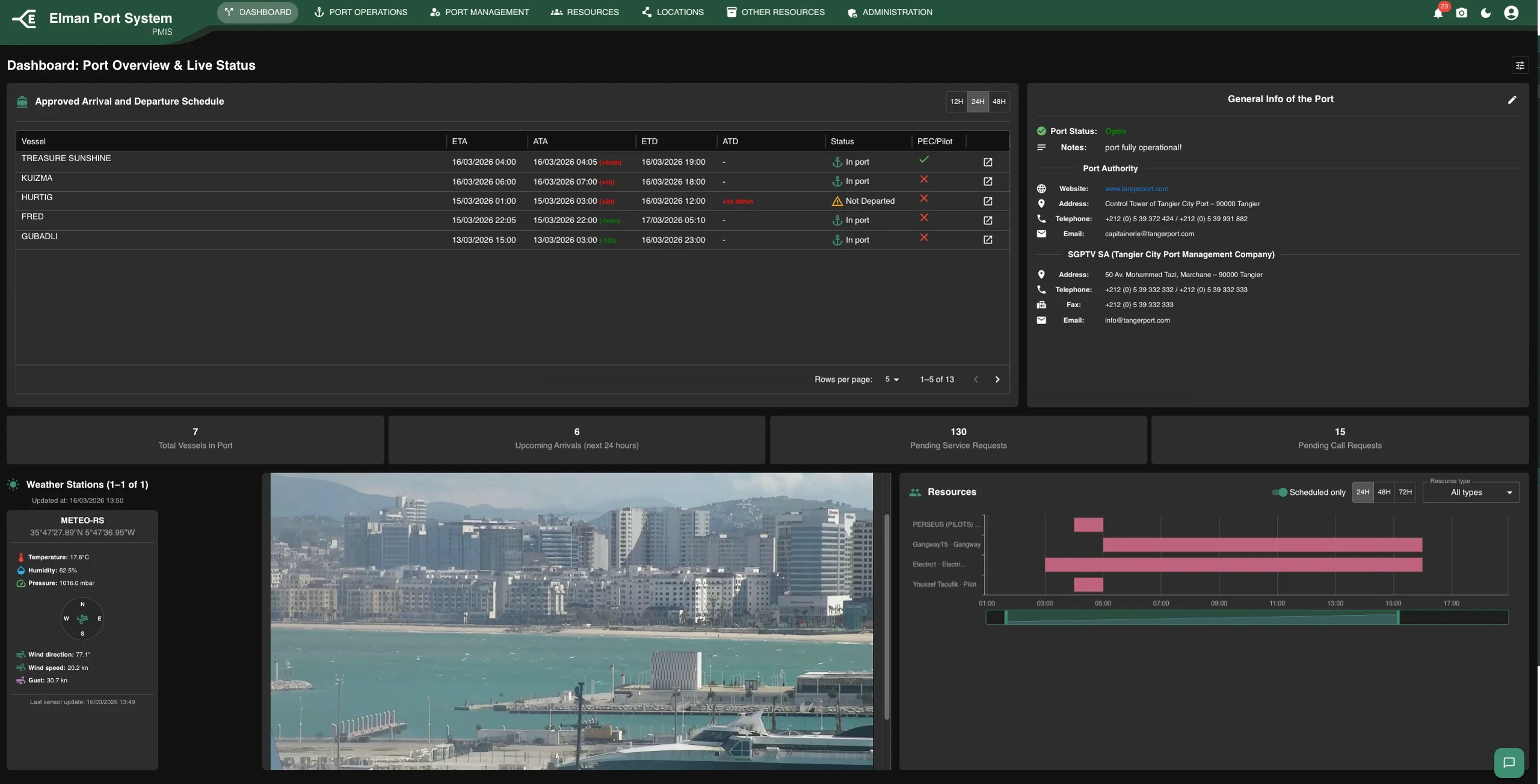
A Port Management Information System is an integrated software platform that manages the administrative, operational and commercial activities of a port. It connects every stakeholder, from shipping agents and terminal operators to customs and health authorities, in a single, real-time data environment.

The PMIS is the digital representation of the port community system (PCS): a neutral data hub through which all parties exchange information about vessel calls, cargo movements and regulatory compliance, replacing paper-based and bilateral communication with structured digital flows.

Reduced dwell time

Real-time KPIs

Regulatory compliance

Port call timeline

From pre-arrival to departure, managed entirely within PMIS

-72 h

Pre-arrival notification

Agent submits FAL forms, cargo manifest, crew list and dangerous goods declaration via NSW

-72 h

Pre-arrival notification

Agent submits FAL forms, cargo manifest, crew list and dangerous goods declaration via NSW

-24 h

Authority clearances

Customs, health and border police process declarations; port authority confirms berth availability

-24 h

Authority clearances

Customs, health and border police process declarations; port authority confirms berth availability

-4 h

Resource booking

Pilot, tugs and mooring gang confirmed; berth allocated; terminal notified of expected arrival

-4 h

Resource booking

Pilot, tugs and mooring gang confirmed; berth allocated; terminal notified of expected arrival

0

Pilot boarding

Pilot boards at pilot station; VTS monitors the approach and provides information, advice or instructions as required

0

Pilot boarding

Pilot boards at pilot station; VTS monitors the approach and provides information, advice or instructions as required

+1 h

Berthed & cleared

Vessel moored; port state control inspection if selected; cargo operations commence

+1 h

Berthed & cleared

Vessel moored; port state control inspection if selected; cargo operations commence

Ops

Cargo operations

Container exchanges, bulk loading, stores and fuel delivery tracked in real time by PMIS

Ops

Cargo operations

Container exchanges, bulk loading, stores and fuel delivery tracked in real time by PMIS

ETD

Pre-departure

Port dues invoice issued; departure clearance granted; pilot and tugs re-booked

ETD

Pre-departure

Port dues invoice issued; departure clearance granted; pilot and tugs re-booked

Dep.

Departure

Vessel departs berth; PMIS closes port call record; SafeSeaNet notified of departure

Dep.

Departure

Vessel departs berth; PMIS closes port call record; SafeSeaNet notified of departure

PMIS functional modules

Select a module to explore its capabilities

Port Call Management

Cargo Management

Single Window / NSW

Resource & Berth Planning

Port Call Management

The central module managing the entire vessel visit lifecycle — from pre-arrival notification through departure. Every action is time-stamped and shared with all relevant parties.

Pre-arrival notification 24 h/72 h in advance (Dir. 2002/59/EC Art. 4 / SOLAS XI-2/9 ISPS)

Pilotage and towage booking and tracking

Port dues calculation: tonnage, length, cargo type, stay duration

Berth assignment and conflict resolution

Vessel movement records: arrival, berthing, shifting, departure

Port call performance KPIs: berth occupancy, turnaround time

More

Port Call Management

Cargo Management

Single Window / NSW

Resource & Berth Planning

Port Call Management

The central module managing the entire vessel visit lifecycle — from pre-arrival notification through departure. Every action is time-stamped and shared with all relevant parties.

Pre-arrival notification 24 h/72 h in advance (Dir. 2002/59/EC Art. 4 / SOLAS XI-2/9 ISPS)

Pilotage and towage booking and tracking

Port dues calculation: tonnage, length, cargo type, stay duration

Berth assignment and conflict resolution

Vessel movement records: arrival, berthing, shifting, departure

Port call performance KPIs: berth occupancy, turnaround time

More

IMO FAL Convention forms

The Convention on Facilitation of International Maritime Traffic (FAL, 1965) standardises the documentation required at international ports. PMIS handles all FAL forms digitally via the NSW.

FAL 1

General Description

Basic vessel data, voyage details, port of call information

FAL 2

Cargo Declaration

Description of all cargo on board — inbound and outbound

FAL 3

Ship's Stores Declaration

Consumables, spare parts and equipment on board

FAL 4

Crew's Effects Declaration

Personal effects of crew members for customs purposes

FAL 5

Crew List

Complete list of crew with nationality, rank and passport number

FAL 6

Passenger List

Passenger manifest for passenger vessels and ferries

FAL 7

Dangerous Goods

IMDG-classified cargo details: class, UN number, quantities

FAL 8

Maritime Health Declaration

Health status of crew and passengers for port health authority

Port community stakeholders

All parties connected through the PMIS ecosystem

Port Authority

Berth allocation

Berth allocation

Port dues

Port dues

Masterplan compliance

Masterplan compliance

Harbour Master

Safety oversight

Safety oversight

Entry permits

Entry permits

PSC inspections

PSC inspections

Customs / Tax Auth.

Cargo clearance

Cargo clearance

Manifest checks

Manifest checks

Seizures

Seizures

Shipping Agents

FAL submission

FAL submission

Port call mgmt

Port call mgmt

Vessel liaison

Vessel liaison

Electronic data interchange standards

UN/EDIFACT

International standard for electronic data interchange in trade and transport. Used for cargo manifests, customs declarations and shipping instructions.

IFTMCS (cargo status)

IFTMCS (cargo status)

CUSCAR (customs cargo)

CUSCAR (customs cargo)

COPARN (container pre-advice)

COPARN (container pre-advice)

XML / JSON APIs

Modern REST and GraphQL APIs using XML or JSON for real-time data exchange between PMIS, customs systems, terminal operating systems and shipping lines.

Port call notifications

Port call notifications

AIS/ETA updates

AIS/ETA updates

Berth confirmations

Berth confirmations

IMO Compendium

IMO's data standardisation framework defining common data elements for port reporting, aligned with ISO standards and the Single Window concept.

Harmonised data elements

Harmonised data elements

Code lists

Code lists

Message formats

Message formats